My Personal Take on Angle-Shooting
In live poker, especially MTT, the skill is not only math. It’s the “human being” part: how you behave at the table, what you talk about, whether you answer the “exploit” questions people put to you.
That’s what I love about MTT. You’re not playing like a robot running GTO. You’re playing a person, and sometimes that person is playing you rather than playing your range.
Before I get to angle-shooting, I want to write down two things I think every MTT player has run into.
The table “friend”
There’s always a “hustle” guy at the table. He catches up with everyone, jokes around, talks about life, and works especially hard on whoever is sitting right next to him. He leans over and whispers what he had, and why he folded or bluffed the way he did.
I don’t care about any of it. That information is invalid until I see a showdown.
The problem comes later. When we end up in a real spot against each other, I play seriously, and in that moment everyone at the table is an opponent, including him. So I bust him. And then he wants to know why I acted like that, why not ABC, why not XYZ. He doesn’t take my fist bump for the GG.
That’s the moment the “friend” shows he had less respect for me than the act suggested. It changes nothing about how I play. At the table I play seriously and without bias, on my own system, no matter who is sitting across from me.
I think everyone wants to believe they play as professionally as they can. But when they lose, somehow the mistake is never theirs.
”What did you have?”
Then there’s the guy who can’t see your cards because he’s the one who folded: to your preflop 3-bet, to your river value bet, to your river bluff. And he always asks. What did you have?
I’ve never understood the motivation behind it. How is he going to know whether my answer is true?
With these players I usually just smile and give half of the truth. Something that even confuses me a little on the way out.
Now, angle-shooting
The easiest way to talk about it is with the most typical example: the “busy” guy.
He jams all-in and he wants a call, so he starts acting like he’s in a hurry: packing up, checking his phone, saying he has to get home.
This is the most “naive” version of an angle I know. I put that word in quotes because I mean the move and not the person making it, and because I can’t find a better one.
But here’s the thing about live MTT with hyper and turbo structures. Plenty of traveling players are doing exactly that for real. They come to the club, buy an entry, play for fun, and they can’t grind seven or eight hours waiting for good hands.
You might think the skill is telling the fake ones from the real ones. For me it isn’t. I don’t care whether it’s an angle or the truth. I act on my hand and my position.
I’m the kind of player who barely talks at the table and stays on the hands. But if someone opens a conversation with me, especially about something that has nothing to do with poker, I’m glad to have it. I think that’s the best protection there is against being exploited.
Two cases
1. The “misclick”: Wakil and Shevliakov
The claim here is that Shevliakov “fake misclicked” with a strong hand in order to induce a shove, and that it worked.
Blinds 60,000/120,000 with a 120,000 big blind ante. Jamil Wakil raises to 270,000 under the gun with QJ. It folds to Aleksandr Shevliakov in the small blind, who looks down at AK and puts out 360,000, which isn’t a legal raise.
Shevliakov’s explanation was that he hadn’t seen the raise sitting in front of him. The floor was called and ruled he had to make the minimum raise, 420,000.
Wakil then moved all in for close to 4,000,000. Shevliakov snap-called. Big slick held and Wakil was out.
Afterwards Wakil wrote that he was “extremely confident that this was an angle” done on purpose.
The part I keep coming back to is the distinction he draws, which he credits to Griffin Benger on the stream. Once the “mistake” happens, it’s simply a different hand, and the only question left is which strategic route you want to take. Adapting to an opponent’s real mistake is one thing. Manufacturing confusion in order to gain an edge while hiding what you’re actually doing is another.
That’s the whole definition of angle-shooting for me. Not “did he break a rule,” but “was the confusion on purpose.”
I have no way of knowing whether it was here. Nobody does except Shevliakov.
2. A bluff without a bet: Khanna and Nguyen
Both players had already locked up a big score, $170,000 to the winner after a heads-up chop. Then they played one of the strangest hands you’ll see.
Nguyen limps the button with K♠5♣. Khanna checks the big blind with K♥6♥.
Flop: 6♦ Q♦ Q♥. Khanna, the shorter stack, flops two pair and checks. Nguyen bets 600,000, one big blind. Khanna check-raises to 1,800,000. A fold was the expected outcome, but Nguyen calls with king high and about 7% equity.
Turn: 6♣. Khanna now has a full house. He checks again, and that check induces a bet of 1,500,000 from a player still holding king high, drawing to a two-outer for a chop. Khanna check-raises to 4,000,000.
This is where it falls apart. The livestream graphics showed the raise as all-in. Nguyen snap-called, or shoved, and nobody could tell which. The floor came over.
Nguyen looked disappointed that the bet wasn’t actually all-in, maybe because he’d already planned a river bluff, maybe because he thought his hand was good. He stood up and gave his rail a fist bump like he’d just won, trying to sell the idea that he had the best of it. The floor ruled the bet was 4,000,000 and that he had to call that amount.
River: 3♠. No help to anyone. Khanna checked. Nguyen shoved. Khanna mucked his full house instantly. Then Nguyen tabled his cards, and it didn’t look like a player showing a bluff to the crowd. It looked like a player making the point that he’d read his opponent for a bluff, which he had wrong, although he’d already won the pot anyway.
What interests me is how much information leaked out of the argument itself. The gap between “4 million” and “all-in” can’t be settled after the fact if you keep a straight face through the whole thing. And by getting so invested in the controversy, Khanna advertised that he wasn’t holding the nuts and wasn’t comfortable, which is exactly the read that lets someone shove a busted king high at him on the river.
So the lesson I take is a simple one. If you can’t say exactly what you mean, don’t say anything. Put the chips in for the amount you want to bet and let the chips speak. In my experience, announcing bets is the most reliable way to create confusion, especially when the dealer isn’t experienced enough to lock the action down.
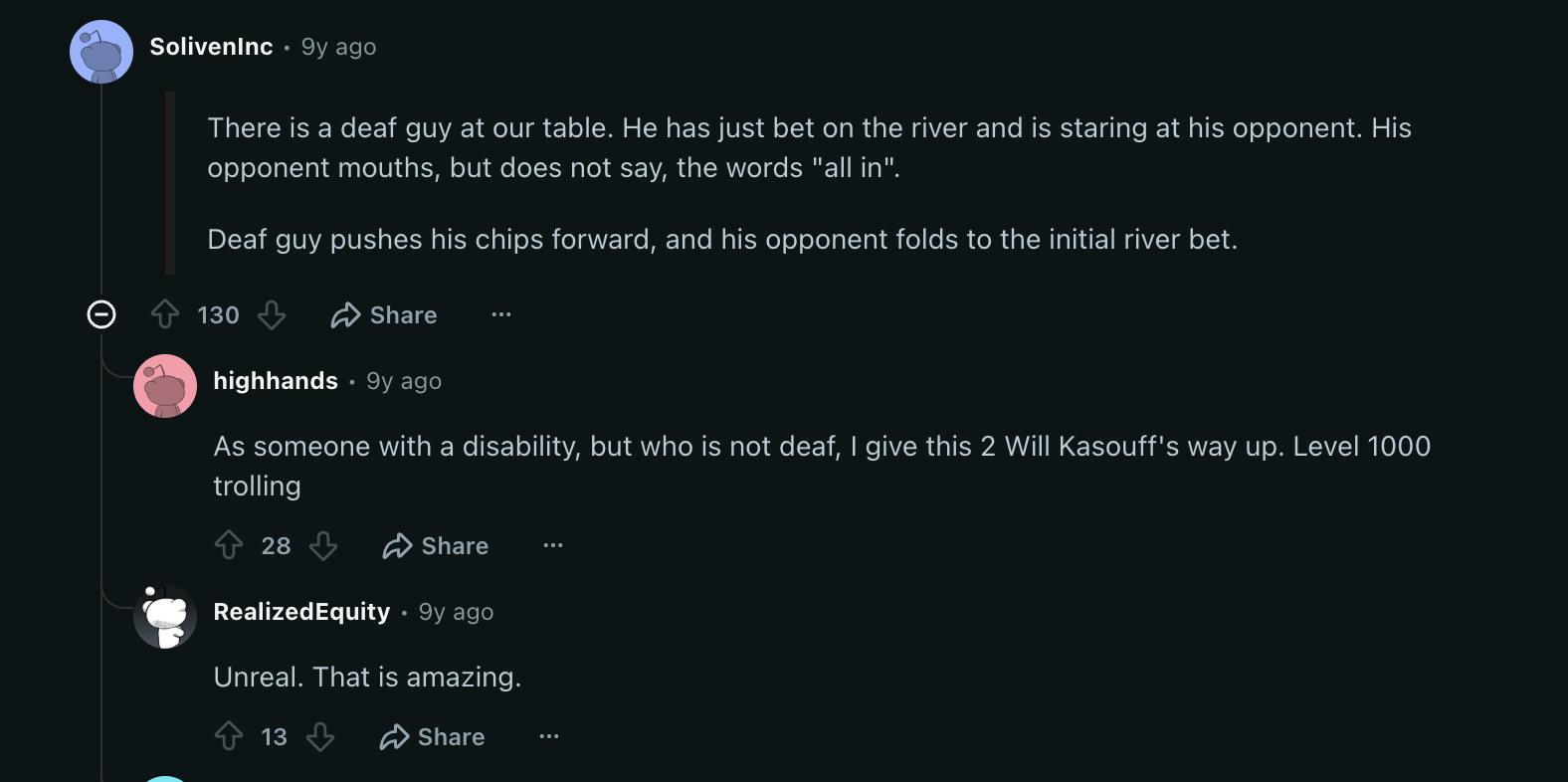
Bonus: the funniest one I’ve read
What I actually do about it
There’s a contradiction in this post and I’d rather name it than tidy it up.
I opened by saying the best thing about live MTT is that it’s human, that you’re playing a person and not a solver. And the conclusion I’ve reached after writing all of this down is: focus on your hand and your position, and don’t base decisions on what people are doing with their bodies and their mouths.
Both are true. The human layer is what makes the game worth playing. It’s also the layer where I’m easiest to attack, because the sighs, the fake rushing, the whispered confessions and the disputed rulings are all cheap for my opponent to produce and expensive for me to read correctly.
So I split it by when, not by whether. The human part happens between the hands. The decisions happen inside them. Talk to me about anything you want. When it’s my turn to act, I’m looking at the board.